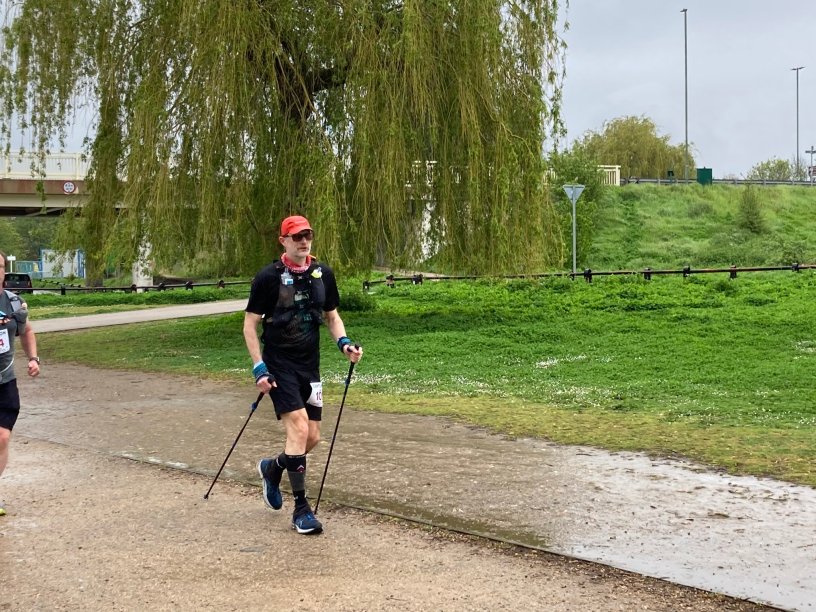
TP100, organised by Centurion Running, is the first of four 100 mile races I will be attempting this year – their 100 Mile Grand Slam. The course is dead flat, more or less, with just a few hundred metres of climb over the whole course – bridges, a couple of small hills, but mostly from the gentle, barely perceptible slope that comes from running upstream.
Rather than take you through 100 miles of rather monotonous riverside route, I’ll structure this report around race management, what went well, what didn’t go so well.
Weather & conditions underfoot
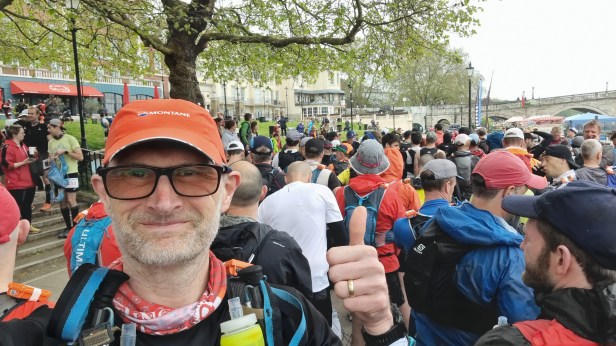
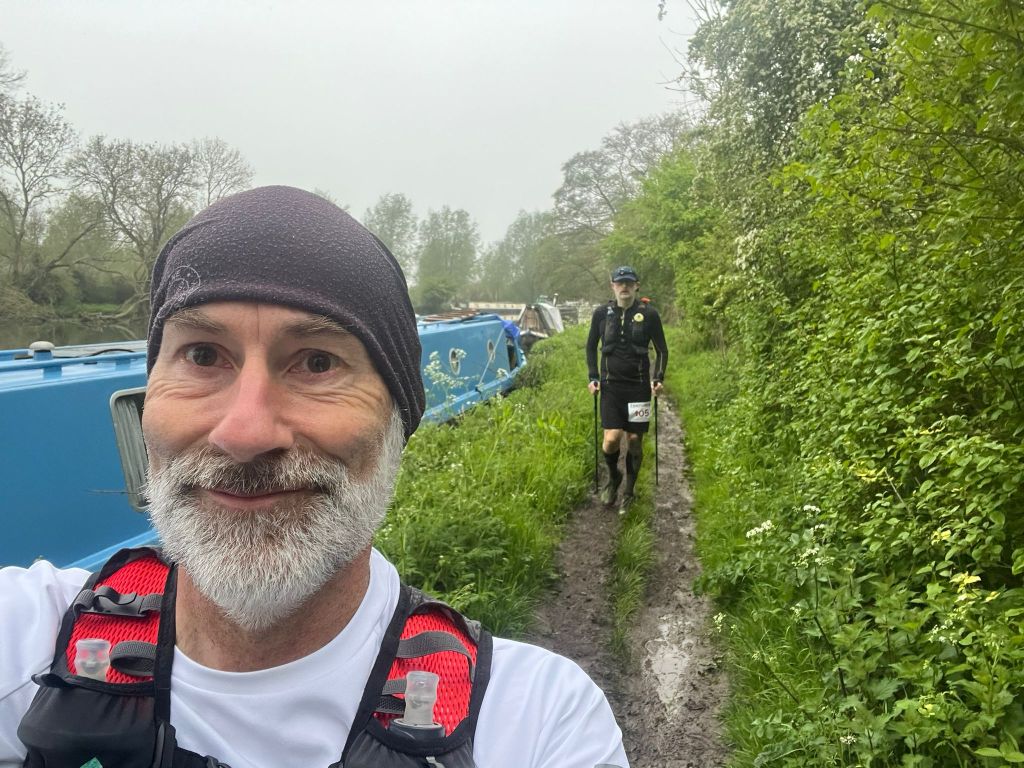
It has been a wet spring here in the UK. Although it had been dry in the week leading up to the race, I was expecting to find conditions underfoot increasingly difficult in the more rural sections in the second half of the race. I was not, however, expecting the never ending quagmire that the course became after 2 days of steady rain. At the start in Richmond it was overcast with some light drizzle in the air, and the forecast was for rain all day, sometimes heavy, until the evening when it was due to stop. The temperature was about perfect for a 100, not too hot, not too cold, not too chilly overnight. About 13 degrees throughout, in fact. I started in a t-shirt, leaving my waterproof in my pack on the basis that I would overheat and get wetter through sweat than I would from the light rain. I did get the waterproof out for a short section either side of Windsor when it really chucked it down for about half an hour. With the rain comes the mud. In the first 40 miles this isn’t too bad, the “trail” is mostly good surface, but as the tarmac and hard-pack gives way to meadows and single-track, it got pretty shitty. Lots of standing water, lots of mud and gloop. Just hard work.
Pacing
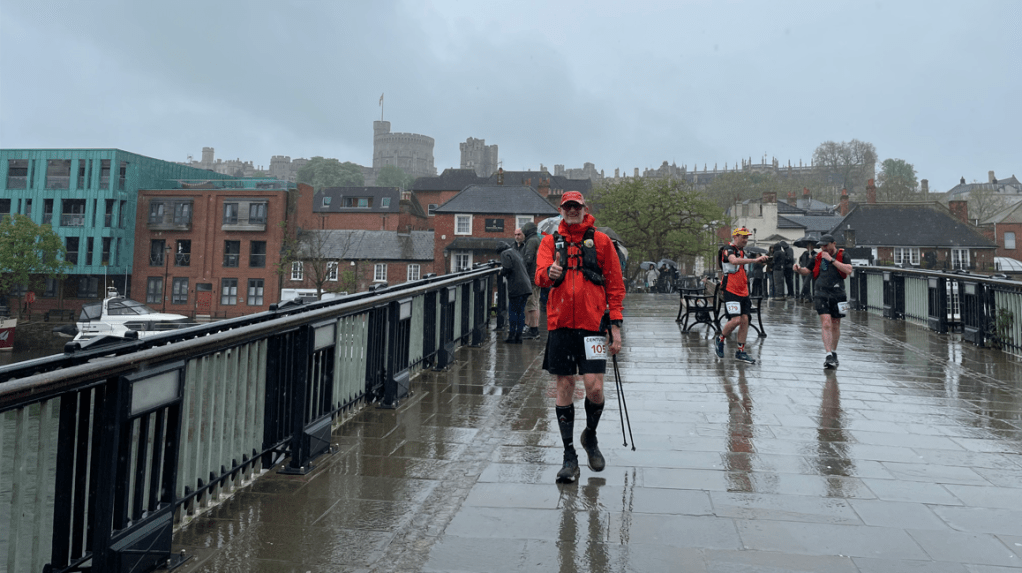
I had a good plan which should have got me to the finish in around 21 hours. I did not factor in wet weather and therefore muddy conditions underfoot, nor did I factor in an overuse injury which was to become a bigger and bigger impediment as the race went on. A flat race sounds like it ought to be easier – no hills, right? – a mistake lots of people make with this race. It’s just as difficult as a hilly race – for a start it’s still 100 miles, a long way, but also you’re using the same muscles in the same way ALL THE TIME. To mitigate this I employed a run-walk strategy from start to finish on this race. Eight minutes running, 2 minutes walking (8:2) for the first half, then 7 minutes running, 3 minutes walking (7:3) in the back half. I thought this would mix things up a bit, give my running muscles and tendons a frequent short rest, plus it would help keep my pace under control at the start. I have form for going off too fast that I wanted to avoid – it’s just a very bad idea on a 100 mile race to piss away all the strength in your legs when you really need it later on. So, poles out after 8 minutes of jogging, click clack for 2 minutes, then jog again. After 3 or 4 of these cycles, nearly all the field had passed me. This might have bothered me, but I was very sure of my strategy, and equally sure I would be seeing the vast majority of these runners later on! Below is my race stats for each section. Of interest here is the 2nd column which is my overall race position. At Walton, the first checkpoint at about 11 miles, I was in 274th of about 330 starters, very much a tortoise and definitely not a hare. As you can see that number comes down at each checkpoint – I pass more and more runners, either on the course or by being more efficient than them at checkpoint admin. I was helped by more than the usual number of people dropping from the race for various reasons. The wheels came off at Clifton Hampden due to an injury, more on this later, so I was passed by a few folks in the final 13 miles. Not many though. I think that picture vindicates the run-walk strategy. I think I’ll be using it again even on the hillier races to come.

Shoe choice
There are those that advocate road shoes throughout on this route. Certainly it’s true that there is no real rough ground, very few places where you’re going to need toe protection, and long stretches of paved or hard packed trail, at least in the first half, where road shoes are definitely a good choice. In the end I opted to start the race in road shoes and change into trail shoes at Henley, the half way mark. This mostly worked well, but with the constant light rain, even the trails in the first were becoming a bit of a mud-fest. I was grateful to have my poles for added stability. I changed into my Inov8 Trailfly G300s at Henley, cleaning and retaping my feet and donning fresh socks in the process. This is a fiddly and time consuming process but I see it as an investment for the second half – there’s nothing more miserable than running on sore and blistered feet. Ten minutes spent here could save me much more than that later on. My only regret was not chucking my more mud-capable trail shoes into the crew box, just in case. I definitely would have changed into those at Benson (75 miles) and had plenty of cause to curse my planning failure – the last 25 miles were a disaster zone – constant sucking mud and deep puddles, churned up by the many passing feet of those that had gone before me. I spent a lot of time slipping and sliding around in my summer trail shoes. There was a lot of creative swearing.
Crew/Pacers
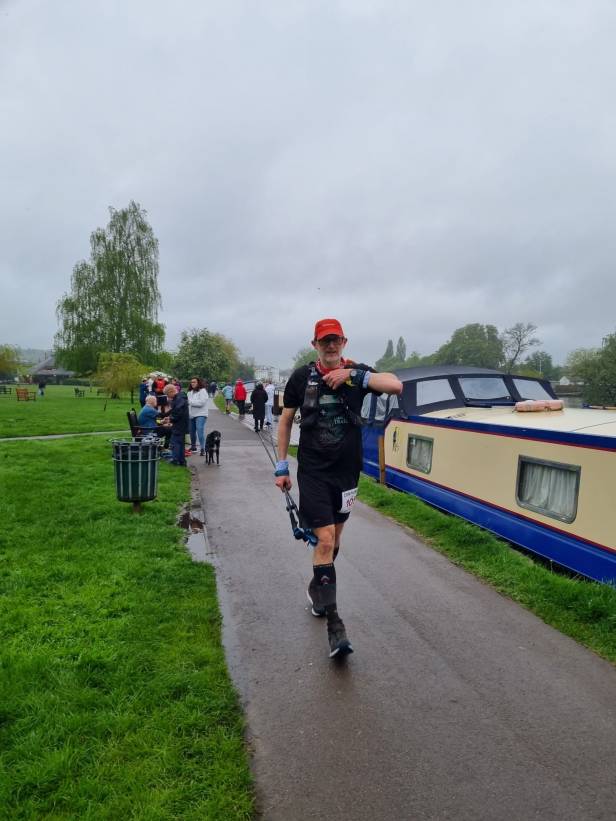
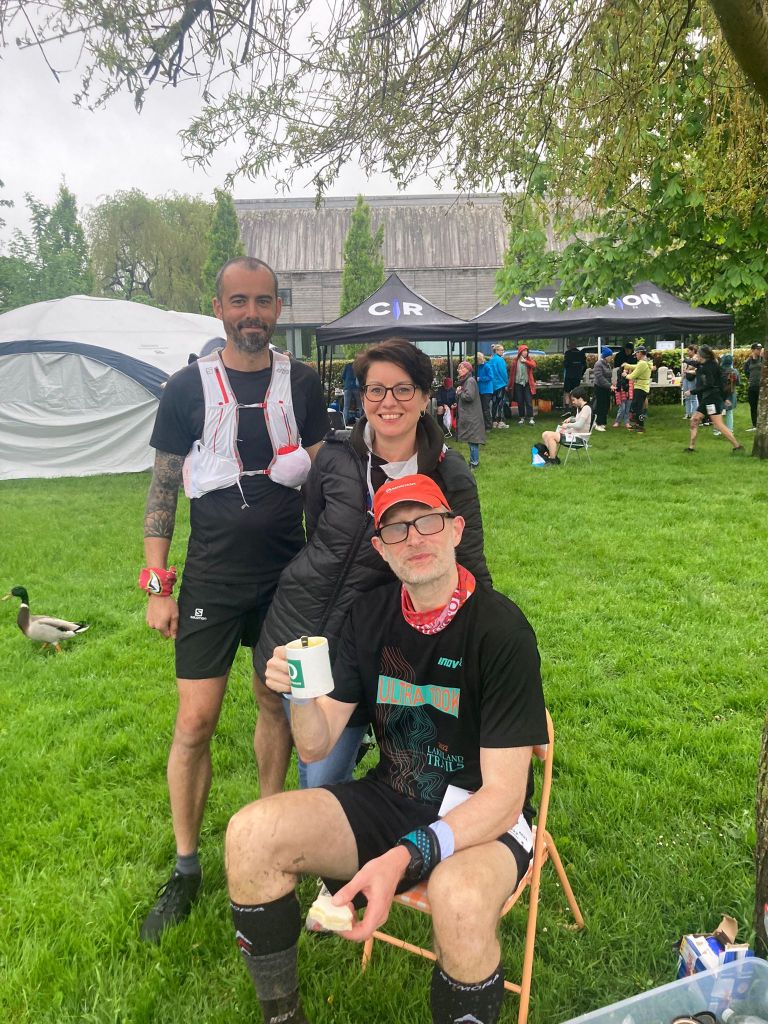
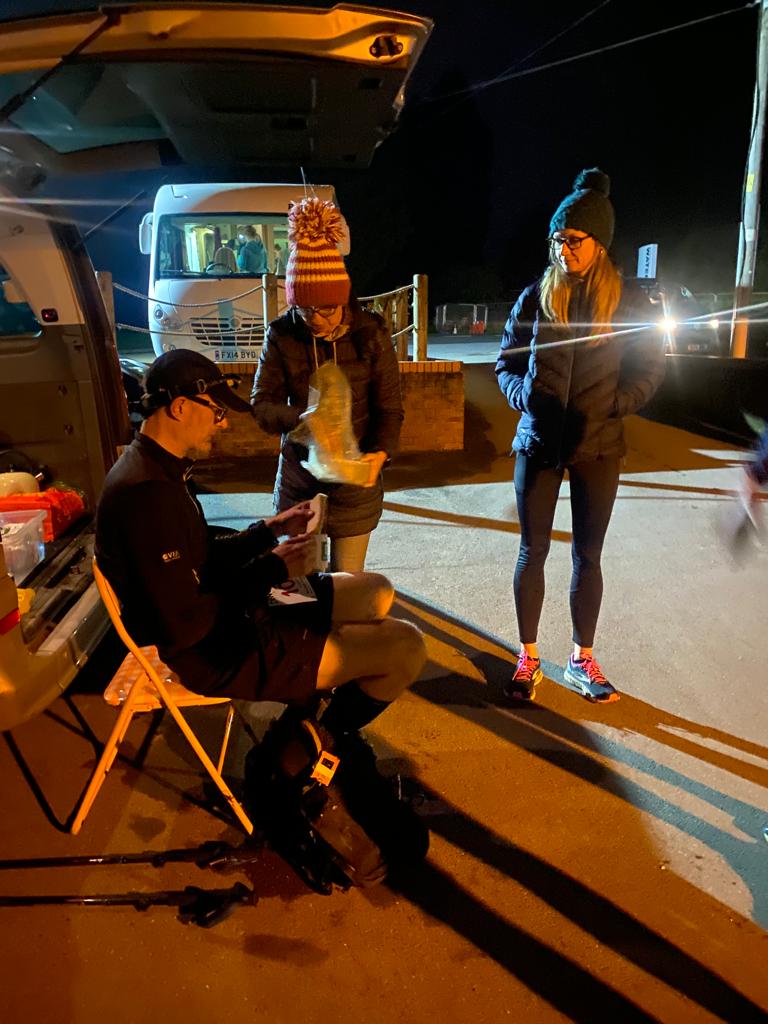
After testing out being crewed at Arc 50 earlier in the year, I was very happy to have crew again for this race. Helen and Rob were awesome, popping up (nearly) everywhere expected with my stuff, efficiently re-stocking me with grub and fluids. At TP100 crew is only allowed in the second half of the race, and only in a handful of designated crew points. We did miss each other at Abingdon, I was through a minute or so before they arrived. Although there were a few people lurking around, I didn’t twig that it was the crew point or I would have called H to find out where they were. We just sailed on, my stomach rumbling. The race allows pacers from half way too, and I was well served in that department. Rob needed to get a run in so he took a break from crewing and paced me from Henley to Reading, about 8 miles. Keith took over at Reading and stuck with me until Benson at 79 miles. We chatted away, well he chatted, I focused on moving my reluctant legs. He had threatened to play some music during his stint but saved that for the final couple of miles. Let’s just say our musical tastes differ considerably – during one particularly dreadful 90s house music track I was heard to mutter “What the FUCK is this awful music Keith!?” Fortunately for my earholes, Colin took over at Benson and stayed with me through the finish. He got more than he bargained for as I had slowed down considerably by this stage. This race was definitely a team effort – I think I would have found it much more challenging to keep going if I was running solo in the latter stages. Much kudos and thanks to Team TP100!

Nutrition & Hydration
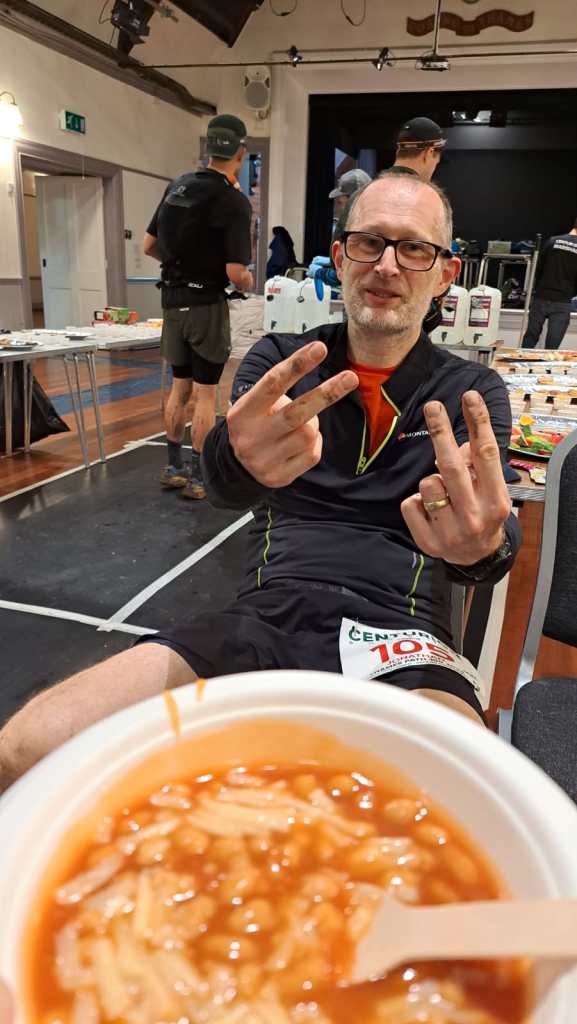
Among the benefits of the run:walk strategy is that I have the opportunity to easily take a gulp of Tailwind and water every 10 minutes. I never felt like I was under-hydrated during the race, helped by it not being very warm out. In the first half I was not crewed so I had little packets of Tailwind for easy transfer to my wide-necked flask – 4 scoops to a packet. It was the work of moments to re-up my tailwind at the aid station. Centurion do provide Tailwind at their aid stations but it’s much more diluted than my preferred strength. With crew help in the second half of the race, it was easy to just swap for full flasks. Fuel wise, Tailwind covers some of my needs but despite their claim that it’s all I need, it isn’t. I planned to eat something every 30 minutes, or every 3rd walk break. This worked well. Eating at the frequency meant I didn’t need to eat a lot. A few jelly babies, some crisps, a couple of chunks of Yorkie, a cheese & jam sarnie whatever I had on me. I did also top up at the aid stations, fruit being a tasty and refreshing option that I wasn’t carrying. At Henley I had some soup and sandwiches. The soup is epic. It’s just cup-a-soup, nothing fancy, but it is fabulous to have something savoury and easy to take on and a soup-dunked cheese sandwich is a lot easier to eat than an un-dunked one. There were points in the later stages of the race, particularly where I was just out on the course for longer than I expected where I was properly hungry, but I wasn’t running by then anyway so no major harm done. Overall, I think that I kept on top of both nutrition and hydration adequately – probably not perfect, but certainly neither became a race-affecting issue.
Checkpoint management
This was a game of two halves. Over a 100 miles with 15-odd aid stations, lingering at each checkpoint or crew stop can really pile up time that could be better spent moving forwards. I was pretty efficient in the first half of the race, getting my admin done, in and out. I use the lap function on my watch to record stops – I have auto-lap switched off for the race, then I press the lap button when I get to a stop, and again when I leave. This also means that my moving lap pace is the overall pace for a given section, a handy way of knowing if I’m sticking to my pace plan (I mostly wasn’t). For checkpoints where I was fiddling with Tailwind powder, I walked the last 100m to the checkpoint and spent that time undoing/emptying flasks and getting the powder in so that I just needed to fill two flasks with water, grab some food and bail. With checkpoint volunteers ready to pour water this was an efficient process. Even at the early checkpoints, I observed a lot of people milling about or sitting down, easy race positions for me to nab. To be fair, I did my share of lingering later in the race.
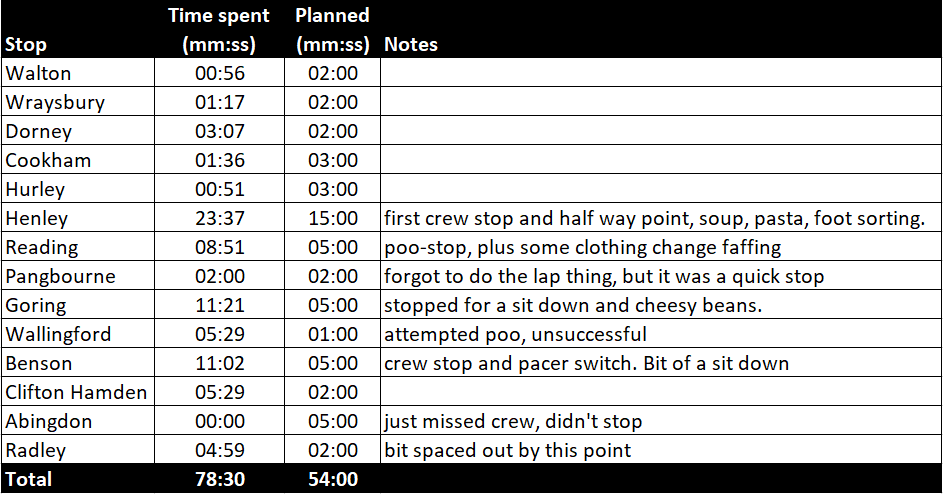
In total I spent 78 and a half minutes at checkpoints and crew points vs 54 minutes in the pace plan, a total of about 24 minutes longer than I intended. Some of that was due to the injury, I needed a rest, but mostly it’s just faffage that comes with the latter stages of the race. This can be improved upon for the next races.
Fatigue/Injury
I was aware throughout the race that my legs in general were holding up very well. I had plenty of running in them and it wasn’t too much of a chore to keep to the 7:3 pattern in the second half. In my only other experience of a 100 miler I found my legs got very tired and sore by about 60 miles. I think this is testament to my training which has gone very well, and also to some pretty focused strength work in the last few months. My legs are strong, and I definitely felt the benefit of that during this race. After the race I did not have too much in the way of DOMS or much fatigue. This bodes well for being ready(ish) for SDW100 which is just 5 weeks after TP100. That’s the good news.

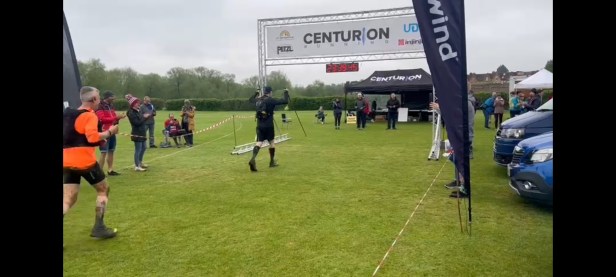
The bad news is that at some point early in the second half of the race I became aware of some pain in my right glute. I could run on it no problem, but transitions from running to walking and vice versa were becoming difficult, as was getting going again after a checkpoint stop. On a normal long run I might have called it a day and phoned in for logistical support. In a race situation that was still an option but obviously much less desirable, especially with the Slam at stake. I continued on, jeffing along at 7:3 as planned but with more and more discomfort and pain, and less and less range of motion. At Clifton Hampden checkpoint I stopped for a couple of minutes to top up fluids and eat something. When we left, I couldn’t run. Literally couldn’t, no choice in the matter. My right leg wouldn’t support my weight in a running gait. I thought that was the end of my race, but with a bit of experimentation I found I could walk ok, although it was quite sore. So with 13 miles muddy miles left to do, I was reduced to a hike. It took Colin and me 4.5 hours to do that half marathon! It was hard going. I was capable of a decent hiking pace still, but we rarely got the chance to use it due to conditions underfoot. Super difficult end to the race. When we started hiking at 88 miles, the ETA on my watch was 7:30 am, or a finish time of 22h30. As our slow rate of progress in the final miles influenced the ETA, it crept up 1 or 2 minutes at a time. I was concerned that the sub-24 might have gone out the window, but with a couple of miles to go it settled at 08:39 or 23h39), quite a bit longer than the 21ish hours I was expecting to finish in.
Aftermath
I sat down for a bit at the finish, but when it was time to go home, I couldn’t move. At all. My legs, particularly the injured right glute, had just seized up. With some assistance I did eventually hobble the 20 yards to the car, but not without difficulty or pain. This was not a good sign. When we got home half an hour later, I couldn’t get out of the car. I couldn’t rotate my legs, or stand up. I had to basically fall out of the car and shuffle along on my bum, up the front steps and continued in similar bum-shuffle order up the stairs, into the bathroom and into the bath. I spent the next 2 days in bed, in quite a lot of pain and unable to move except to struggle the 5 or 6 paces to the nearest loo. This was not the normal post-100 reduction in mobility. I was in big trouble, it seemed. Tuesday was a little bit better, and Wednesday better still. It remained very difficult to move about, and stairs were still a big issue. I went to see a physio on Wednesday evening, who diagnosed an overuse injury in my right glute medial muscle. He declared it unlikely that I’d done any acute damage, no tears or anything, and that with rest and rehab it should improve. I felt embarrassed to tell him that I had another 100 mile race in 4.5 weeks. He was polite enough not to laugh me out of the treatment room, instead giving my right arse cheek a good massage and sending me off with some gentle rehab exercises to do. As I sit here now, 8 days after finishing the race, things are much improved. I still have pain at the injury site, but I can move about with no real difficulty, just a slight limp. I feel encouraged by progress so far and SDW100 is very much on at this point.
I’ll be back next month, hopefully with tales from the South Downs.
 unwilling veteran
Well done on bringing it home – the conditions were evil! We had a lot of drops at Clifton Hampden so a massive high 5 for persevering.
LikeLiked by 1 person